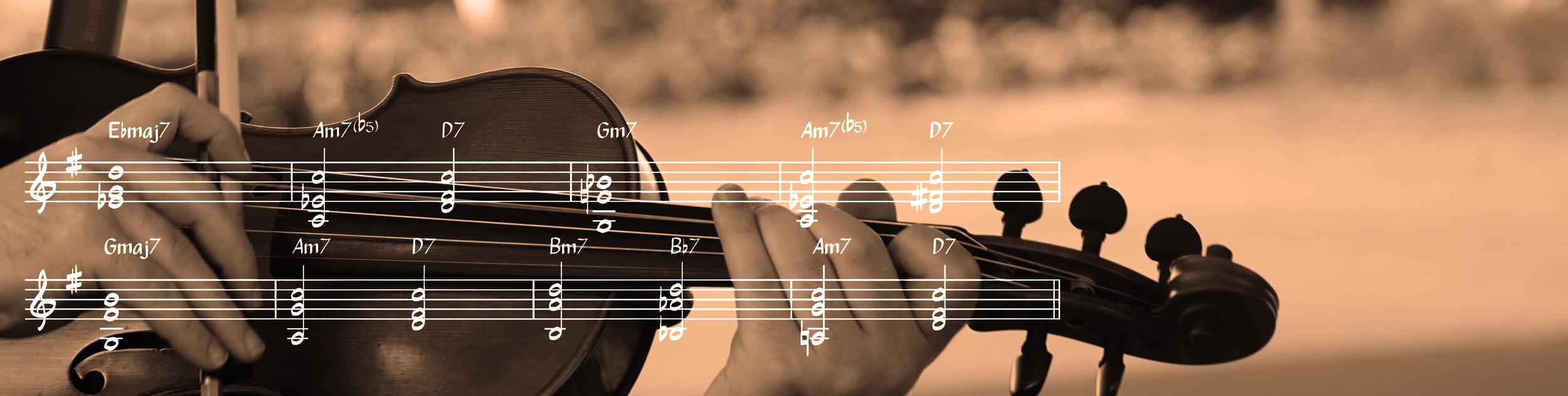
Play, think, and improvise like a harmony instrument!
Unlock harmony and groove by playing chords! A method designed for classically trained string players to map out the fingerboard and develop their ear, improvisation, and groove!
The Violin Chord Method
Step 1: Unlock Basic Chord Shapes (Triads)
The Problem: Traditional classical training teaches us to read and think horizontally, focusing on single note lines, scales, and arpeggios. Although we do learn vertical chord shapes in some classical repertoire like the solo Bach Sonatas and Partitas, we are rarely taught to recognize these shapes as the chords and qualities they are, and we certainly aren’t taught to use these shapes to play our own harmonic progressions.
The Method Solution: Learn your basic shapes using the “3 Shape Violin Chord System for Triads”! Understand how you can play any major or minor chord you see with these basic shapes, and how you can move between inversions to create smooth voice-leading within chord progressions.
Strum these triple-stop chords with the instrument under your arm like a guitarist and/or with your bow!
Step 2: Simplify Complex Chords into Shell Voicings
The Problem: Seeing a bunch of chord changes flying past can feel terrifying, especially if those chords have 7’s, 9’s, 11’s, or 13th on them. String players usually don’t have a way to quickly simplify these chords into shapes we can recognize and use.
Because of this, most string players are only used to REACTING to the chords that we hear from a backing track or rhythm section, instead of really internalizing the musical colors they contain.
The Method Solution: Learn the various 7th chord arpeggios in the “Circle of Fourths + 7th Chord Qualities” resource.
Watch the “How to think and play like a HARMONY instrument! 7th chords + ii-V-I progression”videoto learn how to simplify any chord you see into one of the two possible Root Position Shell Voicings (Root, 3rd, 7th or Root, 7th, 3rd) and how they tend to move throughout common jazz chord progressions like the ii V I.
Strum these triple-stop chords with your instrument under your arm like a guitarist first, then experiment with your bow!
Use various Full Tune Looping/Comping Guides to practice moving around your shell voicings with smooth voice-leading.
Step 3: Command Your Own Rhythm
The Problem: Rhythm is everything, and it’s way more important than playing the correct notes! Just like how we often react to harmony, we also tend to react to groove instead of taking charge of it ourselves.
The Method Solution: Take your new chord shapes and transform them into live rhythmic accompaniment. From steady quarter-note gypsy swing strumming to percussive chopping, learn to drive the pulse of any ensemble by physicalizing your groove, referring to the “Common Comping Rhythms” resource for common jazz rhythms.
Step 4: Keep Exploring!
Apply shell voicings to various tunes, and recognize common chord progressions within whatever style of music you are playing.
For Jazz, see the “Common Jazz Chord Progression Formulae” resource for a great start!
I have room in my private teaching studio for more students right now!
If you are interested in taking online video lessons with me to develop your groove string skills please reach out!
I will teach you how to swing, improvise, and feel comfortable playing your instrument within ANY genre without feeling like an imposter!
I work with my students to create an individualized plan of study tailored to their interests and needs to get them where they want to go - I currently have students learning Classical, Jazz, Klezmer, and Pop/Rock styles with me.
I particularly enjoy exposing traditional classically trained violinists to different groove-based genres and exploring new musical languages with them while deepening harmonic understanding.
I am very passionate about teaching and maintain an international studio teaching violinists of ALL LEVELS and ages online (I love working with children AND adults!), primarily through online video services as well as in-person at my studio in Miami, FL. I am also the adjunct Lecturer of Jazz Violin at Florida International University - it’s a great program that does offer a Jazz Violin degree!
I’m extremely flexible as far as scheduling goes, and I have online students who meet with me weekly, bi-weekly, or just whenever they feel like they’re ready for another lesson.
As someone who is absolutely not a natural ‘theory person’ I completely understand how scary jazz music theory can seem and I am confident that I can teach it effectively to anyone through using the perfect 5ths tuned instrument you’re already familiar with.
Please CONTACT ME with any questions or if you’re interested in having a lesson!
~ Steffen
Jazz Violin Lesson: How to Think and Play like a HARMONY Instrument!
Overview of 7th Chords + ii V I chord progression on the Violin
Black Orpheus: Bossa Nova Comping Lesson
Bossa Dorado - Comping and Improv Lesson
How to play Jazz Violin: Featuring ‘Fly me to the Moon’ and focusing on developing your ear to imitate different instruments accurately
Jazz Violin Pedagogy and Other Resources
A few additional notes on these resources and on developing language within different musical languages:
LISTENING is the most valuable thing in developing within any musical language, especially within groove-based musics like Jazz. Work on transcribing the phrasing and rhythms of melodies as well as solos, taking care to match EVERYTHING including exact rhythms, articulation, vibrato, ornaments, dynamics, etc. Check out the Recommended Creative String Players List to expose yourself to various improvising string players I love, but definitely don't limit yourself to only listening to strings!
I tend to focus on the harmony and rhythmic aspects of Jazz when working with most classically trained violinists, since the harmony itself is a language that you may not be too used to (unless you play a ton of Gershwin!) These resources below are geared towards helping develop harmonic understanding and jazz harmony.
The first thing I’d recommend you practice is the Circle of Fourths Worksheet. You should memorize a method to move around within the circle of fourths like the pattern suggested there. I'm sure you've seen jazz exercises where they give you a lick and tell you to now ' play this in all 12 keys'. Most of us coming from classical backgrounds have no idea how to actually do this, so it’s very valuable to have a system for moving within the circle of 4ths (also known as the circle of 5ths when going backwards). This worksheet also shows the different types of basic 7th chords (the building blocks of jazz harmony) and how they're formed.
Also available on this page are chord only charts of standard Blues progressions and Jazz Standards to get you familiar with the basic 7th chord ‘Shell Voicings’ (scale degrees 1, 3, and 7) that are playable on violin, either strummed guitar style or with a bow as triple or double stops. Use these chord charts to get used to intelligent voice leading from chord to chord, and to start thinking harmonically in chord shapes, like a guitarist would. You can also use these chord charts to create your own looping versions of various pieces. I have a Video on YouTube where you can see me loop this exact Fly Me to the Moon chord chart strummed in straight quarter notes, followed by me playing the melody and improvising. It's also important to listen and study up on what types of 'comping' (improvised accompaniment) rhythms work within them. We call this improvised accompaniment 'Comping' in jazz. I suggest starting with straight short quarter notes all the way through (so 4 per measure usually) and then practicing them using other common patterns like the ones suggested in my Common Comping Rhythms worksheet.
This page contains FREE educational materials I have created to help those interested in developing their Jazz skills.
Many of these are part of my dissertation:Harmony and Rhythm for Jazz Violin: A Pedagogical Method for Classically Trained Violinists which you can access online HERE.
Feel free to use and share these resources for yourself or your students!
Resources for the Modern Violinist:
Jazz Theory and Chord Practice:
Full Tune Looping/Comping Guides: